Summary:
If you’ve been researching retaining walls for more than an hour, you’ve probably read the same article five different times. Same two options, same vague cost ranges, same non-answer at the end. What you actually want to know is which material is going to hold up on your specific property — a Long Island yard with sandy soil, hard winters, and maybe a slope that’s been slowly losing ground for years.
That’s what we’re going to cover here. No filler, no oversimplification. Just a straight comparison of concrete block and natural stone retaining walls, grounded in what we’ve seen work — and fail — across Nassau County.
What "Concrete Block Retaining Wall" Actually Means
Before comparing anything, it helps to clear up a terminology issue that trips up a lot of buyers. “Concrete block,” “cement block,” “cement retaining wall blocks,” and “segmental retaining wall blocks” are all terms people use to describe essentially the same category of product. Technically, cement is an ingredient inside concrete — but in everyday use, a cement retaining wall and a concrete block retaining wall refer to the same thing. You’re not missing something if these terms feel interchangeable, because for most practical purposes, they are.
What separates modern retaining wall blocks from the plain gray CMU blocks you might picture is engineering and finish. Today’s concrete retaining wall blocks are purpose-built for ground contact, drainage, and structural load. Many are dry-cast to precise tolerances and tested to ASTM C1372 standards, which govern compressive strength, absorption, and freeze-thaw durability — all things that matter a great deal in a Nassau County winter.
Interlocking Blocks for Retaining Walls: How They Work and Why It Matters
The most common type of concrete block retaining wall sold today is the interlocking segmental block — and understanding how it works explains a lot about why it performs the way it does.
Each block is shaped with a built-in lip, pin channel, or lug on the back that locks it to the course below. This creates a wall that steps slightly backward into the slope — a built-in lean called “batter” — which is one of the key reasons these walls resist the outward pressure of soil behind them. No mortar is required. The blocks hold together through their own geometry, gravity, and in taller walls, geogrid reinforcement layers that extend back into the compacted fill.
For walls under three feet on relatively flat ground, interlocking blocks for retaining walls are genuinely DIY-friendly. The installation sequence is straightforward: excavate, set a compacted gravel base six to twelve inches deep, lay the first course below grade, stack subsequent courses with the setback built in, and backfill with clean drainage stone as you go. The gravel backfill and a perforated drain pipe behind the wall are what prevent hydrostatic pressure from building up — which, for the record, is the single most common reason retaining walls fail regardless of what they’re made from.
For walls over four feet, the calculus changes. At that height, you’re dealing with significantly more soil load, and in Nassau County, local building departments in Hempstead, North Hempstead, and Oyster Bay each have their own permit thresholds and engineering requirements. Some municipalities require a permit for walls as low as two feet. It’s worth a quick call to your town’s building department before you start, not after.
The installed cost for a concrete block segmental retaining wall typically runs $20–$35 per square foot, which includes materials, base preparation, drainage, and labor. That range makes it one of the more cost-effective structural options for walls under six feet.

Does Concrete Block Actually Look Good, or Does It Look Like a Basement Wall?
This is the objection we hear most often, and it’s fair — if you’re picturing the plain gray blocks from a big-box store, the concern makes sense. But that’s not what the retaining wall block market looks like anymore.
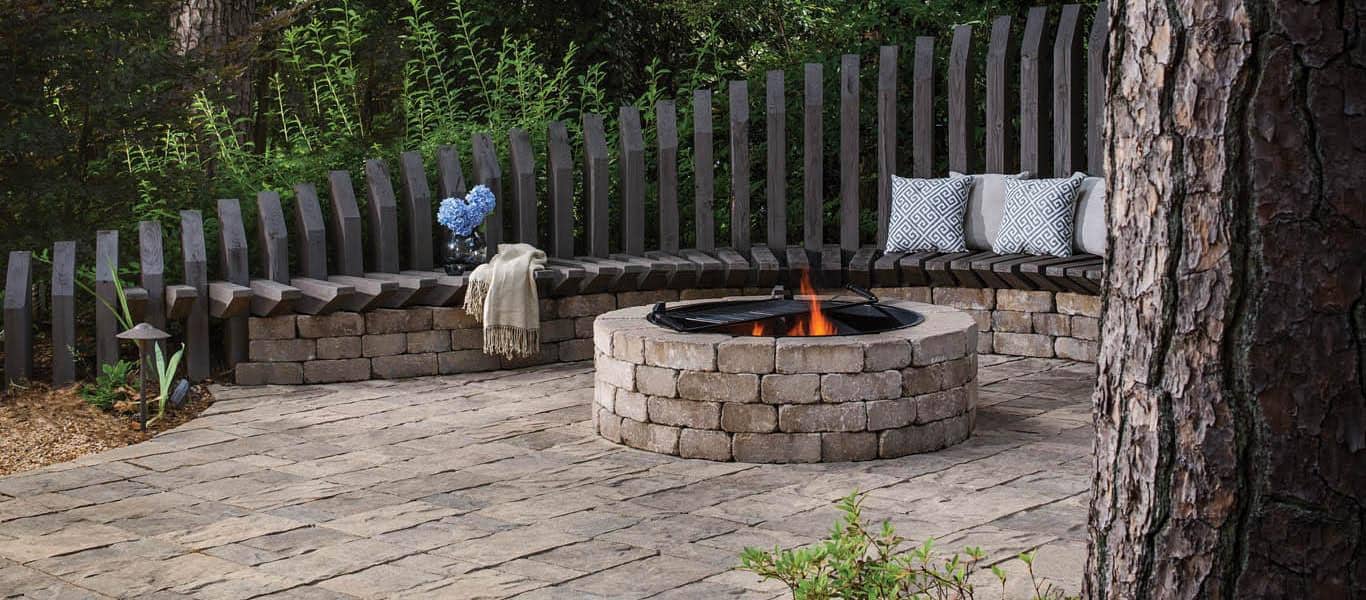
Modern concrete retaining wall blocks are available in tumbled, split-face, and textured finishes that closely mimic the look of natural fieldstone, granite, and aged limestone. LibertyStone’s TrueTumbled line features a fully tumbled surface that replicates the worn, organic texture of old European cobblestone — we carry it at our East Setauket location. Belgard and EP Henry both offer block systems with multiple color blends and face textures that, once installed, are genuinely difficult to distinguish from natural stone at a normal viewing distance.
The aesthetic gap between concrete block and natural stone has closed dramatically over the past two decades. The buyers who still assume concrete block looks cheap are often working from an image that’s twenty years out of date. If you’ve seen a retaining wall recently that you thought was natural stone, there’s a reasonable chance it was concrete block retaining wall blocks with a textured finish.
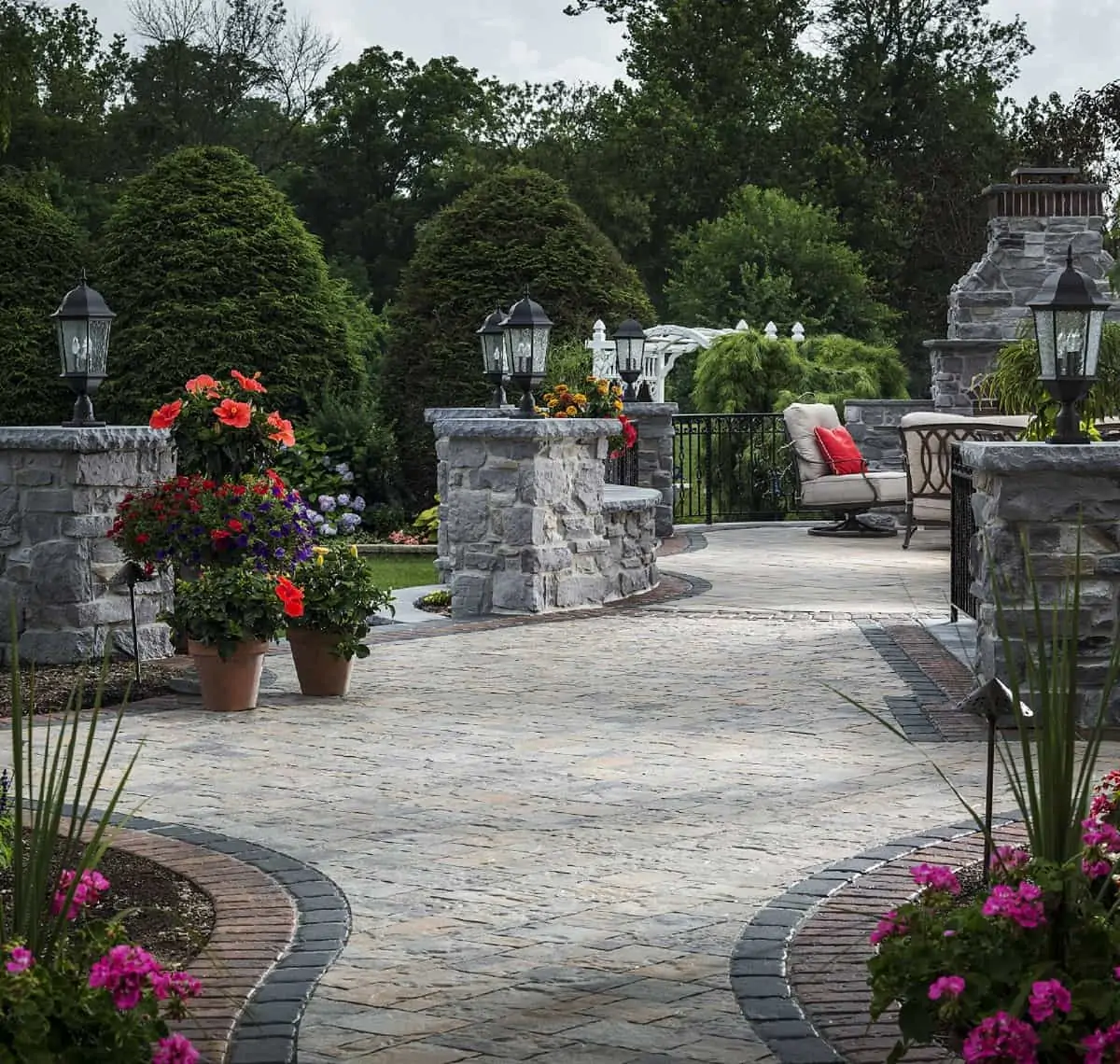
That said, natural stone does have a visual quality that’s hard to fully replicate — particularly dry-stacked fieldstone or bluestone with natural color variation and irregular edges. If you’re building a feature wall in a highly visible location and the budget allows, natural stone has an organic character that some buyers find worth the premium. The honest answer is that both materials can look excellent; the difference is in the specific product, the installation quality, and what you’re comparing them to.
Natural Stone Retaining Walls: Where They Excel and Where They Fall Short
Natural stone retaining walls — built from fieldstone, granite, bluestone, or armour stone — have a well-earned reputation for longevity. A properly built dry-stack stone wall can last 75 to 100-plus years. That’s not marketing language; there are stone walls in this region that have been standing since before the Long Island Expressway existed.
The catch is that “properly built” is doing a lot of work in that sentence. Natural stone walls depend heavily on the skill of the mason. The stones have to be fitted carefully to distribute load evenly, and without the engineered geometry of interlocking blocks, the wall relies on mass and craftsmanship to stay in place. When drainage is inadequate — and it often is — the pressure from saturated soil behind a stone wall will eventually move it, no matter how well the face looks.
Natural Stone Retaining Wall Cost vs. Concrete Block: What the Numbers Actually Look Like
The installed cost for a natural stone retaining wall typically runs $25–$50 or more per square foot, depending on the stone type, wall height, and site conditions. Compare that to the $20–$35 per square foot range for a concrete block segmental wall, and for a 40-foot wall at three feet high — a pretty common residential scale — you’re looking at a potential difference of $1,500 to $6,000 or more between the two options.
That gap is significant, but it’s not the whole story. Natural stone’s longer lifespan — when installed correctly — can make the higher upfront cost more defensible over a 30- or 40-year ownership horizon. The question is whether you’re going to own the property long enough for that math to work in your favor, and whether the installation quality will actually deliver on the longevity promise.
There’s also the maintenance dimension. Natural stone walls, particularly dry-stacked ones, can shift over time. Individual stones can work loose. Weeds and even small animals can find their way into gaps. Concrete block walls with proper drainage and cap blocks on the final course require very little maintenance once they’re in. For Nassau County homeowners who want a wall that functions reliably without ongoing attention, that’s a real practical advantage.
One thing worth knowing: the material cost alone for concrete block retaining wall blocks is typically $10–$20 per square foot, which is meaningfully lower than natural stone before you factor in labor. If you’re working with a contractor and want to understand what you’re actually paying for, separating material cost from installation cost is a useful exercise.

What Nassau County's Soil and Climate Actually Do to a Retaining Wall Over Time
Most retaining wall comparison guides are written for a general national audience, which means they skip the details that actually matter if you’re building in Nassau County, NY. The local conditions here are specific enough that they should influence your material decision.
Nassau County sits on glacial geology — the Harbor Hill moraine runs along the North Shore, creating the rolling hills and bluffs that give areas like Oyster Bay, Roslyn, and Port Washington their topography. South of the moraine, the terrain flattens into glacial outwash plains with sandy, fast-draining soils. Those sandy soils are actually a double-edged situation: they drain well, which reduces hydrostatic pressure risk, but they shift easily under load and during storm events, which increases erosion risk and puts lateral pressure on retaining walls over time.
Add to that the freeze-thaw cycle. Long Island winters run repeated freeze-thaw events from roughly November through March, with frost penetration reaching around 36 inches deep. Every freeze-thaw cycle expands and contracts the soil behind a retaining wall. Over years, that movement is cumulative. Concrete blocks meeting ASTM C1372 are specifically tested for freeze-thaw durability — they’re engineered not to crack, spall, or degrade under that kind of repeated stress. Natural stone is inherently durable, but improperly fitted stones in a dry-stack wall can be displaced by frost heave in ways that are harder to predict and more expensive to repair.
The coastal proximity adds another layer. Properties near the Long Island Sound or the South Shore bays deal with high water tables, salt air, and the kind of storm surge and heavy rainfall that puts real stress on any retaining structure. In flood zone areas, Nassau County’s zoning regulations often require engineered designs for retaining walls with significant elevation changes — something to confirm with your town’s building department before you commit to a material or a contractor.
The bottom line for Nassau County specifically: concrete block retaining walls built with proper gravel backfill, filter fabric, and drain pipe behind the wall are well-suited to local conditions. The drainage system matters as much as the block itself. Any wall — concrete or stone — that’s built without proper drainage is eventually going to have problems, regardless of how good the material is.
Which Retaining Wall Material Is Right for Your Nassau County Property?
Here’s the honest answer: for most residential retaining walls in Nassau County under six feet, concrete block is the stronger practical choice. It costs less to install, performs predictably in freeze-thaw conditions, requires minimal maintenance, and — with the right product — looks far better than most people expect. Natural stone earns its place when budget isn’t the primary constraint, the wall is highly visible, and you have a skilled mason who will get the drainage right.
What matters most in either case isn’t the material itself — it’s the installation quality and the drainage system behind the wall. A well-drained concrete block wall will outlast a poorly drained stone wall every time.
If you’re in the planning stages and want to see both options in person before committing, we carry Belgard, EP Henry, LibertyStone, and Hanover Architectural Products at our East Setauket location — all displayed on-site across an eight-acre yard you can actually walk through. Our team at Troffa Materials Corporation has been helping Long Island homeowners and contractors make these decisions since 1972, and we’re happy to talk through what makes sense for your specific site.