Summary:
Every spring, homeowners across Nassau County notice the same thing: a retaining wall that looked fine in October is now leaning, cracking, or pushing outward at the base. It’s not bad luck. It’s what happens when the wrong material meets 30 to 50 freeze-thaw cycles in a single winter season — which is exactly what Long Island delivers, year after year.
Choosing a retaining wall material isn’t just an aesthetic decision. It’s a climate decision. This guide walks you through what actually survives Nassau County winters, what tends to fail, and what to think about before you commit to any material.
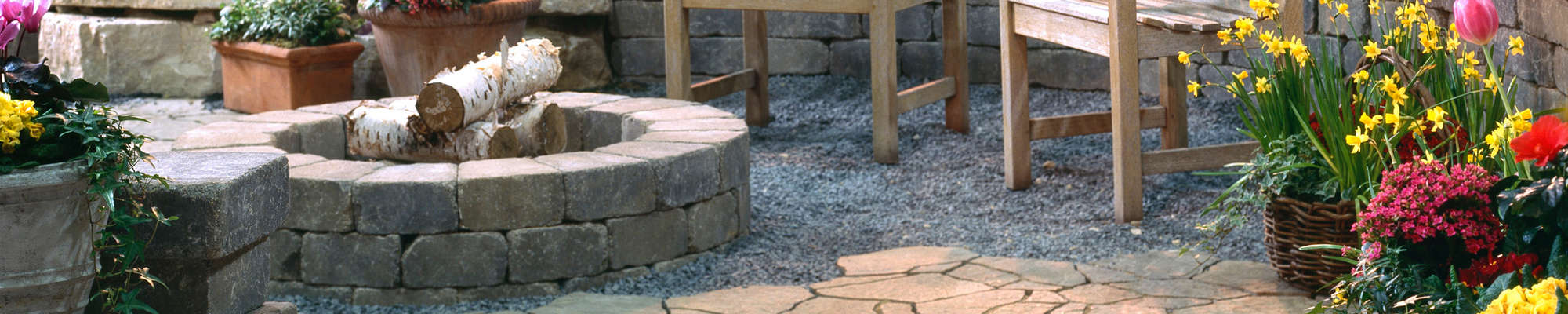
Dry Stack Retaining Wall Blocks: Why No Mortar Works Better in Cold Climates
The phrase “dry stack” throws some people off. No mortar sounds less sturdy, not more. But in a freeze-thaw climate like Nassau County’s, dry stack construction is one of the smartest choices you can make.
Here’s the simple reason: mortar absorbs water. When that water freezes, it expands — by about 9% — and that expansion cracks joints, spalls brick faces, and slowly works the wall apart from the inside. Dry stack walls have no mortar joints to fail. Water drains freely through the gaps between stones, which means there’s no place for ice to build up pressure.
When the wall is built correctly — with a proper compacted gravel base, a slight backward lean into the slope, and stones that interlock rather than just stack — a dry stack natural stone wall can last 50 to 100 years or more with almost no maintenance. We’ve watched this play out across Nassau County properties for decades.
What kind of stone works best for a dry stack wall?
Not every stone is suited for dry stack construction, and this is where a lot of DIY projects go sideways. The key is shape. Flat, angular stones — think fieldstone, bluestone, or ledgestone — lock together like puzzle pieces. Each course naturally grips the one below it, and the weight of the wall works in your favor. Rounded stones, like river rock, look appealing in a garden bed but shift unpredictably under load. They’re not a reliable choice for a structural wall.
For Nassau County properties, fieldstone has a long history of use precisely because it’s well-suited to the region’s soil and climate conditions. It has an organic, weathered look that complements both traditional colonial-style homes common across Oyster Bay and North Hempstead and the more naturalistic landscapes on the North Shore bluffs near Port Washington and Manhasset. If you want cleaner lines, cut limestone or granite gives you a more structured appearance while still performing well in dry stack applications.
The other thing worth knowing: sourcing stone locally matters more than people think. Local stone is more available, easier to match if you need to extend or repair the wall later, and it tends to complement the surrounding landscape in a way that imported stone sometimes doesn’t. We’ve been supplying stone across Long Island since 1972, and we can tell you that the walls built with regionally appropriate materials consistently outlast the ones built with whatever happened to be cheapest at the time.
Plan to order 10 to 20% more material than your square footage calculation suggests. Cutting, shaping, and fitting stone creates waste, and you’ll want to have extra on hand rather than waiting on a second delivery mid-project.

Mortared stone walls in cold climates: What you should know
Mortared natural stone walls aren’t a bad choice everywhere — but in Nassau County, they come with real trade-offs that are worth understanding before you commit.
A well-built mortared wall looks sharp. The joints are tight, the face is clean, and the whole structure has a formal, finished quality that dry stack can’t quite replicate. For certain properties — particularly in more manicured neighborhoods or where the wall is highly visible from the street — that aesthetic matters.
The problem is durability in freeze-thaw conditions. Mortar is porous. Even with proper sealing and quality materials, water finds its way into the joints over time. In Nassau County, where ground frost can penetrate 18 to 36 inches deep and temperatures regularly cross the freezing threshold dozens of times each winter, that water expands and contracts repeatedly. The result is spalling — small chips and cracks that start at the surface and work inward — and eventually joint failure.
A mortared wall without excellent drainage behind it is especially vulnerable, because hydrostatic pressure from saturated soil compounds the freeze-thaw stress. If you do choose mortar, drainage has to be part of the plan from the start — not an afterthought. That means a gravel backfill layer (typically around 12 inches) between the soil and the wall, filter fabric to prevent soil migration into the gravel, and weep holes or gaps to let water escape rather than build up.
For most Nassau County homeowners who want natural stone? Dry stack performs better over time, costs less to maintain, and handles Long Island winters with less intervention. Mortared walls can work — but they require more planning and more upkeep to get there.
Stone retaining wall cost: What to expect by material type
Cost is usually the first question, and it’s a fair one. But the number that matters most isn’t the upfront price per square foot — it’s what you’re paying per year of service life. A wall that costs less to install but needs replacing in 15 years isn’t necessarily the better deal.
With that framing in mind, here’s a realistic look at how the most common retaining wall materials compare in terms of cost and longevity — particularly for Nassau County projects, where New York metro labor rates push installed prices toward the higher end of national ranges.
Boulder retaining wall cost and performance
Boulder walls tend to surprise people — both in how good they can look and in how well they hold up. There’s a common assumption that boulders are for large commercial or agricultural projects, but that’s not really accurate. On North Shore Nassau County properties — especially in areas like Oyster Bay, Cold Spring Harbor, and along the bluffs near Port Washington — boulder retaining walls fit naturally into the landscape and handle the topographic variation those properties often come with.
In terms of freeze-thaw performance, boulder walls are among the most resilient options available. There’s no mortar, so there are no joints to crack. The sheer mass of the stone provides stability, and water moves around and between boulders rather than building up behind the wall. For properties that have struggled with erosion or drainage issues — particularly after nor’easters or the heavy rainfall events that hit Nassau County’s South Shore communities — a boulder wall is a serious, long-term solution.
Installed costs for boulder retaining walls typically run in the range of $20 to $45 per square foot, depending on boulder size, site access, and the complexity of the installation. The lower end of that range is competitive with natural fieldstone, and the maintenance demands over time are minimal. If the site allows for it and the aesthetic works for your property, boulders are worth serious consideration — not just as a utilitarian option, but as a design choice that can genuinely enhance a landscape.

Bin block retaining wall systems: The practical option for larger projects
Bin blocks — sometimes called ecology blocks or interlocking precast concrete blocks — don’t show up in many residential conversations, but they should. These are large, heavy precast concrete units that stack and interlock without mortar, typically used for commercial retaining applications, material storage yards, and large-scale slope stabilization. But they’re increasingly being specified for residential projects where the scale of the wall or the load it needs to support goes beyond what standard segmental blocks or natural stone can handle cost-effectively.
The freeze-thaw performance of bin blocks is solid. Like dry stack stone, there’s no mortar to fail. The interlocking design keeps units in place under load, and the concrete itself is dense enough to resist the kind of surface spalling that affects brick or lower-quality manufactured blocks. They’re not a beauty-first choice — the look is utilitarian and industrial — but for retaining large amounts of soil on a steep slope, or for a wall that’s more functional than decorative, they get the job done reliably.
Installed costs for bin block walls typically run $30 to $60 per square foot depending on block size and site conditions. For Nassau County homeowners dealing with a significant grade change — a steeply sloping backyard, a property that borders a road or neighboring lot at a much lower elevation — bin blocks can be the most cost-effective structural solution available.
One thing to keep in mind: for any retaining wall over four feet in height, Nassau County municipalities generally require a building permit, and taller or load-bearing walls may need an engineer’s review. That’s true regardless of material. It’s worth checking with your specific town or village — whether you’re in the Town of Hempstead, North Hempstead, or Oyster Bay — before breaking ground.
Choosing the right retaining wall material for Nassau County
Long Island winters are not forgiving to walls that weren’t built with the climate in mind. Timber fails fastest — typically within 10 to 20 years once moisture gets in. Mortared walls can work, but only with proper drainage and the right materials for cold-weather conditions. Manufactured segmental blocks are a reasonable mid-range option. Natural stone and boulders, built dry stack with a solid gravel base, consistently outperform everything else over the long run.
We’ve been watching these materials perform — and fail — across Long Island since 1972. That’s not a sales pitch. It’s just a long time to observe what actually holds up through decades of Nassau County winters, nor’easters, and spring thaws.
If you’re planning a retaining wall project and want to see the materials in person before you decide, our eight-acre site in East Setauket has everything on display. Troffa Materials Corporation delivers throughout Nassau County, and our team is happy to help you figure out what makes sense for your specific site, slope, and budget — without pushing you toward whatever’s most expensive.