
Summary:
Most Nassau County homeowners don’t think much about their retaining wall — until it starts leaning. Or cracking. Or the soil behind it starts moving in directions it shouldn’t. Then suddenly the question of which block to use becomes very real, very fast.
The good news: choosing the right retaining wall block isn’t complicated once you understand a few things specific to Long Island. The freeze-thaw cycles, the aging housing stock, the sandy glacial soil — these local factors narrow the field considerably. What works in a warmer climate may not hold up here. What looks great in a catalog may not suit your terrain. Let’s walk through what actually matters.
Decorative Retaining Wall Blocks: When the Wall Is Part of the Design
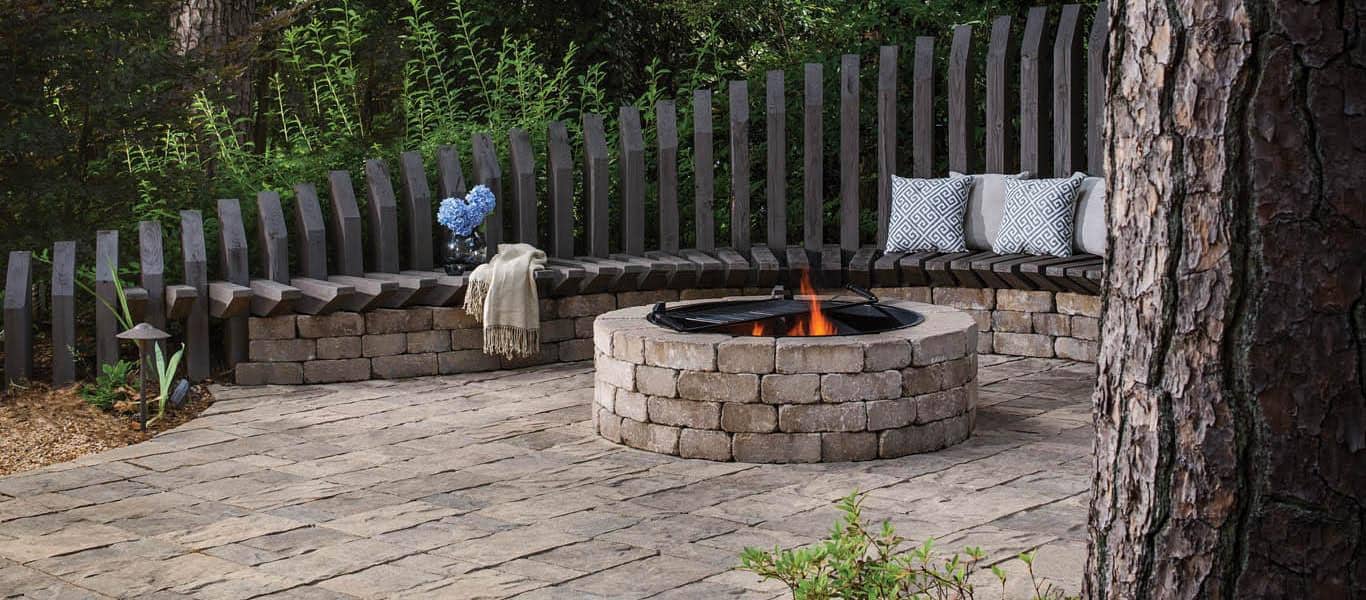
There’s a reason decorative retaining wall blocks have seen significantly higher adoption than plain concrete alternatives in recent years. Homeowners — especially in Nassau County’s North Shore communities like Port Washington, Manhasset, Old Westbury, and Roslyn — are no longer treating retaining walls as purely functional. They’re part of the landscape design. They frame patios, define terraced gardens, and contribute directly to how a property looks from the street.
The blocks themselves have come a long way. Textured finishes that mimic hand-laid stone, tumbled edges that suggest age and character, color blends that complement existing pavers or driveways — these aren’t afterthoughts. They’re engineered features. We carry lines from Belgard, EP Henry, and Libertystone that give you that finished, intentional look without sacrificing the structural integrity the wall actually needs.
How Do You Match Decorative Wall Blocks to Your Existing Hardscape?
This is the question that trips people up most. You’ve already got a patio, maybe a driveway, possibly existing stone edging — and now you need a retaining wall that doesn’t look like it arrived from a different property. The answer isn’t to match exactly. It’s to coordinate thoughtfully.
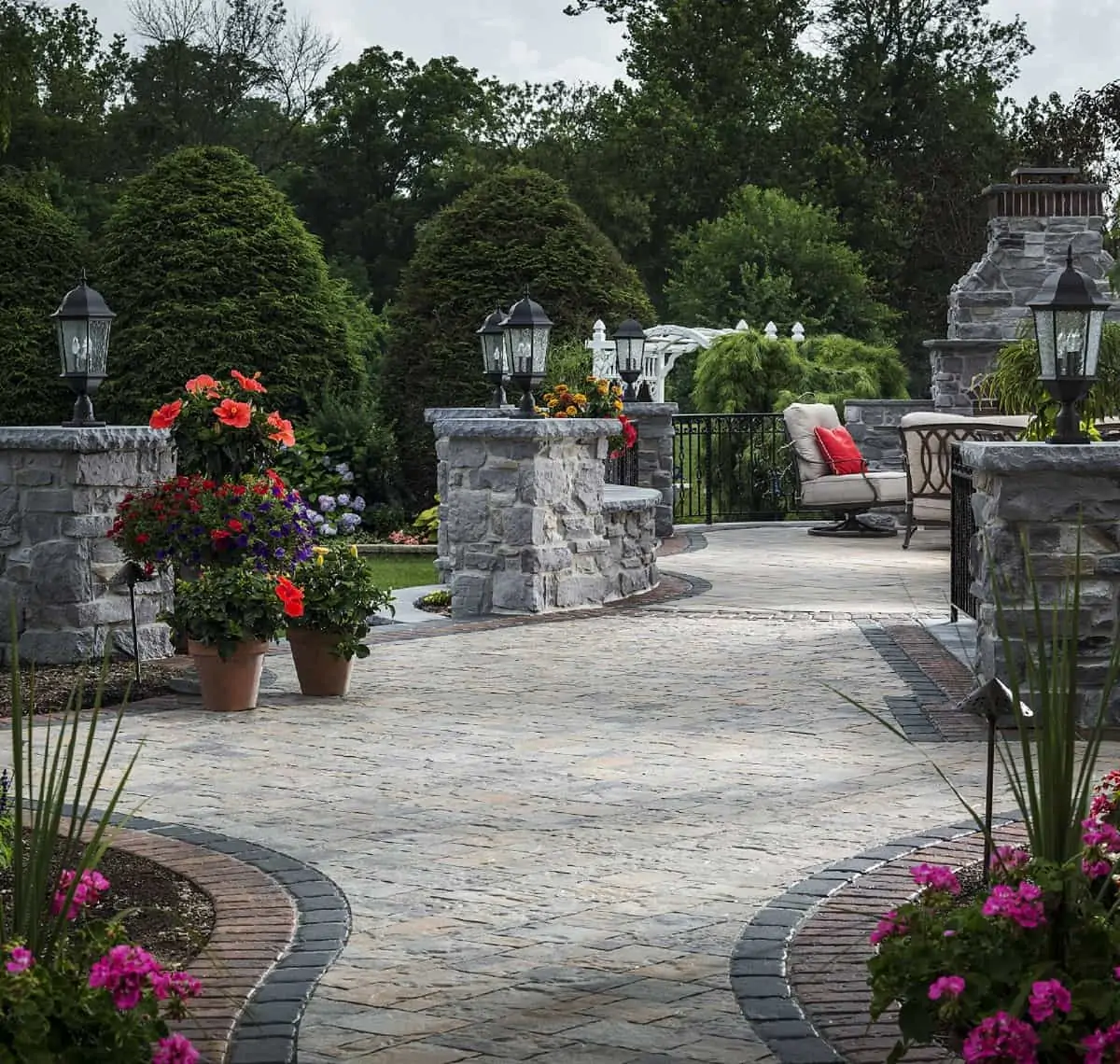
Start with the dominant material already on your property. If your patio uses a warm tan paver, you’re looking for wall blocks in the same tonal family — not necessarily the same color, but close enough that the eye reads them as intentional. Belgard and EP Henry both offer wall systems with coordinating paver lines specifically so you can build a cohesive outdoor space rather than a patchwork of mismatched materials.
Texture matters just as much as color. A smooth, modern block will look out of place next to a rustic flagstone patio. A heavily tumbled, weathered-finish block can feel dated next to clean, contemporary pavers. The texture of the block should echo the overall style of the space — formal, casual, traditional, or contemporary.
One thing that helps enormously: seeing the materials in person before committing. Our East Setauket location has an eight-acre display yard where you can walk the site, compare blocks in natural daylight, and hold them next to samples of your existing materials. That experience — being able to physically see and feel what you’re buying — is something no online retailer or catalog can replicate. For a decorative purchase where visual fit is everything, it matters.
For curved walls, raised planting beds, and terraced garden applications, block geometry becomes a factor too. Some blocks are designed for straight runs only; others are engineered to accommodate curves without cutting. If your project involves anything other than a straight wall, confirm the block system you’re considering supports the radius you need.
Finally, think about the capstone. The top course of a retaining wall is what most people see at eye level, and a well-chosen capstone gives the wall a finished, intentional look that ties the whole thing together. Most wall block systems have coordinating capstone options — don’t skip them.

Small Retaining Wall Blocks for Garden Beds and DIY Projects
Not every retaining wall project is a major structural undertaking. A significant portion of what Nassau County homeowners need is smaller-scale: raised garden beds, low borders along a driveway, a gentle slope in the backyard that needs to be held in place. For these applications, smaller landscape-grade retaining wall blocks are often the right call — and they’re well within reach of a capable DIYer.
The key distinction here is between landscape blocks and structural blocks. Landscape blocks are designed for walls under roughly two to three feet in height where the lateral soil pressure is modest. They’re lighter, easier to handle, don’t require mortar, and most systems interlock in a way that makes installation straightforward for someone who’s comfortable doing their own yardwork. Structural blocks are engineered for taller walls, heavier loads, and situations where failure would cause real damage — they require more preparation, proper base compaction, drainage behind the wall, and often geogrid reinforcement.
For a DIY garden wall project in Nassau County, a no-mortar interlocking landscape block is usually the right starting point. You’ll want a compacted gravel base of at least six inches — don’t skip this step, even for a small wall. The base is what keeps the wall level and stable through freeze-thaw cycles. Even a 12-inch decorative wall will shift if it’s sitting on native soil that freezes and heaves each winter.
Weight is also a practical consideration. Some landscape blocks run 30 to 80 pounds each. If you’re building alone, the heavier end of that range gets exhausting quickly. Lighter blocks in the 20 to 40-pound range are more manageable for solo work without sacrificing stability at low wall heights.
Where DIY typically hits its limit is around three feet. Once you’re past that height, the soil pressure increases significantly, drainage becomes more critical, and the consequences of getting it wrong are more serious — a wall that fails at four feet can move a lot of soil and cause real damage to a yard, a fence, or a neighboring property. At that point, the conversation shifts to structural blocks and, often, a qualified installer.
We’re happy to help you figure out where your project falls. Bring us your dimensions and we can walk you through what’s appropriate for your specific situation.
Commercial Retaining Wall Blocks: What Changes at Scale
Commercial retaining wall projects operate under different rules — literally. In New York, walls exceeding four feet in height generally require a building permit and, in many cases, an engineer’s involvement. For commercial developers, contractors, and property managers working in Nassau County, this isn’t optional. It’s part of the project scope from day one.
The block systems used for commercial applications are engineered accordingly. They’re designed to handle significant lateral loads, integrate with geogrid soil reinforcement systems, and meet the documentation requirements that permit applications demand. We supply contractors throughout Nassau County and Suffolk County with the commercial-grade block systems and accessories — geogrid, drainage aggregate, perforated pipe — needed to build walls that will pass inspection and last decades.
What Do Contractors Need to Know About Retaining Wall Block Supply on Long Island?
For contractors, the supply side of a retaining wall project is where schedules live or die. A delayed material delivery can idle a crew for a day or more — and on Long Island, where project timelines are tight and labor costs are high, that’s a real problem. This is where having a reliable local supplier with actual delivery capacity makes a material difference.
We run a fleet of dump trucks that carry between one and forty cubic yards and flatbed trucks that hold between one and twenty-two pallets. Same-day or next-day delivery is available for most materials. That’s not a marketing line — it’s a logistical reality that contractors working in Nassau County have come to depend on for over fifty years.
Beyond delivery, the other thing contractors consistently tell us matters is product consistency. When you’re building a long wall or a multi-phase project, you need blocks from the same production run to maintain color and texture consistency. Premium brands like Belgard and EP Henry manage this through their manufacturing processes in a way that generic or off-brand alternatives often don’t. Ordering from an authorized dealer — rather than a gray-market or discount source — is what protects you against the mid-project discovery that your second pallet doesn’t match your first.
We also offer competitive pricing and volume discounts for contractors and bulk purchases. If you’re a masonry professional working regularly in Nassau County or Suffolk County, it’s worth having a conversation with us about what that looks like for your business.
One more thing worth noting for commercial projects specifically: geogrid. Any structural wall over approximately three to four feet in height will require geogrid soil reinforcement behind the blocks. This isn’t optional — it’s an engineering requirement built into the design of most segmental retaining wall systems. We stock compatible geogrid along with the drainage aggregate and perforated pipe needed to complete the system correctly. Having everything sourced from one location simplifies the logistics and ensures the components are designed to work together.
Cheap Retaining Wall Blocks: What You Actually Get for Less Money
Budget is a real constraint for a lot of homeowners, and there’s nothing wrong with wanting to spend less. The issue isn’t the desire to save money — it’s what “cheap” actually means in the context of a Long Island retaining wall.
The cheapest option most people find is a standard concrete masonry unit — a CMU, the kind of block used in building construction. They’re inexpensive per unit and widely available. They are also not designed for retaining wall applications. CMUs are engineered for vertical load-bearing in walls and foundations. They are not engineered for the lateral soil pressure that a retaining wall faces, and they don’t have the drainage geometry or freeze-thaw resilience that an engineered segmental retaining wall block provides.
In Nassau County’s climate, where the ground freezes and thaws multiple times each winter, a CMU retaining wall is a wall that’s working against physics every single season. Eventually, it loses.
The more useful question isn’t “what’s the cheapest block?” It’s “what’s the lowest-cost block that will actually hold up?” For most residential applications in Nassau County, that answer lands in the mid-range landscape or entry-level structural block category from a reputable manufacturer — not the hardware store clearance bin, and not necessarily the premium decorative line either. There’s a meaningful middle ground that gives you durability without requiring you to spend at the top of the market.
What drives up the real cost of a cheap wall isn’t the initial material purchase — it’s the rebuild. A wall that fails after three winters costs you the labor to remove it, the disposal of the failed materials, and the full cost of a new wall. That math rarely favors the cheapest block upfront. The freeze-thaw cycles in Nassau County are not hypothetical. They happen every year, and they are the single most common cause of retaining wall failure on Long Island. Blocks and wall systems that are engineered for this climate — and installed with proper drainage — routinely last twenty to thirty years or more. That’s the comparison that matters.
If budget is a real constraint on your project, come talk to us. We can look at what you’re working with and find options that make sense for your situation — without steering you toward a product that’s going to cost you more in the long run.
Where to Buy Retaining Wall Blocks in Nassau County
Nassau County’s housing stock is old, the winters are hard on masonry, and the properties here are worth protecting. Whether you’re replacing a wall that’s been slowly failing since the Eisenhower administration or building something new from scratch, the block you choose and the way the wall is built will determine whether it lasts or whether you’re doing this again in five years.
The right block depends on your wall height, your soil conditions, your aesthetic goals, and your budget — and those factors look different for every project. What doesn’t change is the value of getting good information before you commit to a purchase.
We’ve been supplying Long Island homeowners and contractors with masonry and landscape materials since 1972. Our East Setauket yard is open Monday through Friday from 7:00 AM to 4:30 PM and Saturday from 7:00 AM to 2:00 PM. Come walk the site, see the materials in person, and talk to someone who can actually help you figure out what your project needs. Troffa Materials Corporation is here when you’re ready.