Summary:
You’ve got a slope in the backyard, a grade change along the driveway, or maybe a wall that’s been slowly leaning for a few winters now. You start searching, land on “cement retaining wall blocks,” and suddenly you’re wading through product pages and contractor sites that all say the same thing: durable, long-lasting, built to perform. None of them actually answer the question you’re asking. So let’s do that here. What are these blocks, really? How long do they hold up in Nassau County, where the ground freezes and thaws a dozen times every winter? And what does it actually take to get a wall that lasts?
Types of Retaining Wall Blocks: What You're Actually Looking At
First, a quick clarification worth making: “cement block” is a term most people use, but what they’re describing is a concrete block. Cement is one ingredient — the binding powder — that gets mixed with water and aggregate to make concrete. The finished block is concrete, not cement. It’s a small distinction, but it matters when you’re comparing products, because not all concrete blocks are built the same way or rated for the same applications.
For retaining walls specifically, there are two main categories. The first is the standard concrete masonry unit — a CMU — which is the rectangular hollow block you’ve probably seen used in construction. The second, and far more common for residential retaining walls, is the segmental retaining wall block: a solid, precast concrete unit engineered specifically to stack, interlock, and hold back soil without mortar. These are the blocks we carry at our East Setauket yard, including products from Belgard, EP Henry, Libertystone, and Hanover Architectural Products.
Interlocking Concrete Blocks for Retaining Walls: How They Actually Work
Segmental retaining wall blocks — the interlocking concrete blocks you’ll see in most residential projects — are designed to work without mortar. Each block is shaped so that it sets back slightly from the one below it, creating a natural backward lean called batter. That lean isn’t a flaw; it’s structural. It puts the weight of the wall in the right direction to resist the soil pressure pushing against it from behind.
Because there’s no mortar holding the blocks together, the wall has a small amount of built-in flexibility. That matters more than most people realize. When the ground freezes in January and thaws in March — and on Long Island, that cycle can happen ten to twenty times in a single winter — the soil moves. A rigid mortared wall fights that movement and eventually cracks. A properly built segmental wall accommodates it without losing structural integrity.
For walls taller than three or four feet, geogrid reinforcement gets added into the equation. Layers of a mesh material are embedded between courses of block and extend back into the compacted soil behind the wall, essentially anchoring the wall to the earth rather than just leaning against it. This is standard practice for taller walls and the reason properly engineered segmental retaining walls can last well beyond 50 years.
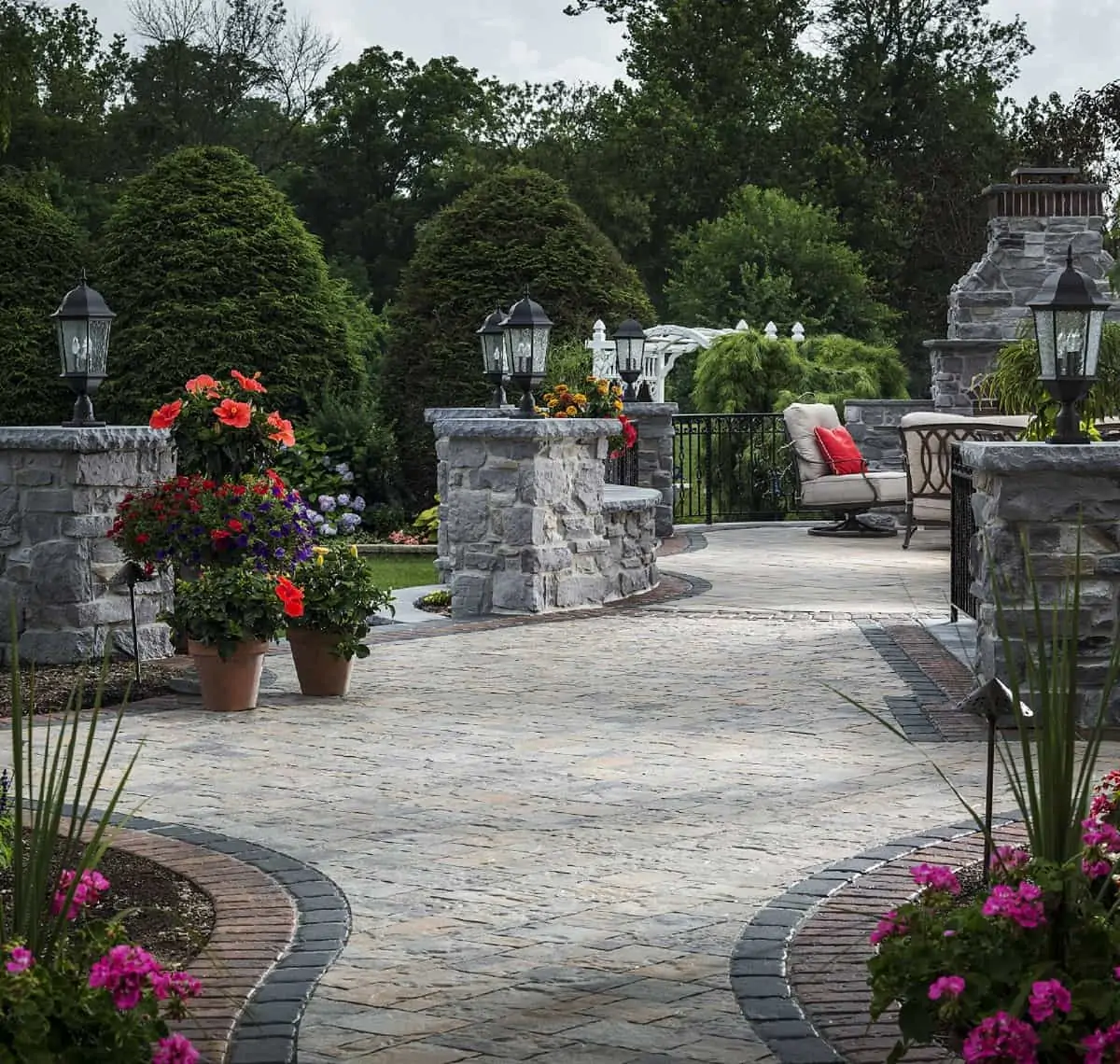
The other thing worth knowing is that these blocks come in a wide range of profiles, textures, and colors. Split-face, tumbled, chiseled — the aesthetic options have come a long way from the industrial gray block most people picture. In a market like Nassau County, where property values are high and curb appeal is part of the investment, that visual variety matters.

Cinder Blocks vs. Concrete Blocks: Not the Same Thing
A lot of homeowners use “cinder block” and “concrete block” interchangeably. They’re not the same product, and the difference is worth understanding before you buy anything.
Cinder blocks were made using coal cinders as aggregate — a byproduct of industrial burning that’s largely gone out of use. They’re lighter than concrete blocks, but also weaker and more porous. Cinder blocks haven’t been widely manufactured in decades, but the name stuck in everyday language. If someone offers you “cinder blocks” for a structural retaining wall application, what they almost certainly mean is CMUs — standard concrete masonry units — which are a different and stronger product.
For a retaining wall, standard CMUs can work, but they typically need to be filled with mortar and reinforced with rebar through the hollow cores to perform structurally. That’s a different installation process than segmental block systems, and it requires more skilled labor to do correctly. The segmental interlocking systems from manufacturers like Belgard and EP Henry are specifically engineered for retaining wall applications from the ground up — they’re not a workaround or an adaptation of a general-purpose block. That engineering is reflected in how they perform over time, especially under the kind of freeze-thaw stress that’s a fact of life in Nassau County, NY.
The short version: if you’re building a retaining wall on Long Island, the block type that makes the most sense for most residential applications is a segmental precast concrete block from a reputable manufacturer. The terminology can be confusing, but the product decision doesn’t have to be.
Retaining Wall Materials: What Determines How Long a Wall Actually Lasts
The honest answer to “how long do cement retaining wall blocks last?” is: 50 to 100 years, sometimes longer — but that number comes with conditions. Belgard puts it plainly: a well-built retaining wall can last 50 years or more with proper installation. Nitterhouse Masonry cites concrete masonry units lasting up to 100 years. Those figures are real, but they assume the wall was built correctly from the start.
The block itself is rarely what fails. What fails is everything around it — the base, the drainage, the backfill. Get those three things right, and a concrete retaining wall is about as close to a permanent structure as residential landscaping gets. Skip one of them, and it doesn’t matter how good the block is.
Why Drainage Is the Hidden Factor Behind Every Retaining Wall Failure
If you’ve ever seen a retaining wall bow outward, crack down the middle, or slowly tip forward over a few seasons, drainage failure is almost always the reason. Water that gets trapped behind a retaining wall builds up hydrostatic pressure — essentially, the weight of saturated soil pushing against the back of the wall with nowhere to go. Even a well-built wall has limits on how much of that pressure it can handle indefinitely.
The fix is straightforward, but it has to be planned before the wall goes up, not after. A perforated drainage pipe runs along the base of the wall at the heel — the back edge — surrounded by clean crushed stone and wrapped in geotextile fabric to keep soil from clogging the pipe over time. That system gives water a path out from behind the wall before pressure can build.
In Nassau County, this matters more than it might in drier climates. The region sees significant rainfall, particularly during spring and fall, and Nor’easters can drop several inches of rain in a short window. Sandy soil — which is what most of Long Island sits on, thanks to glacial deposits — drains relatively well compared to clay-heavy soils, but that doesn’t mean drainage behind a wall can be skipped. The volume of water during a major storm event can exceed what sandy soil handles on its own, and without a designed drainage system, that excess has nowhere to go but into the wall.
The base preparation matters just as much. A compacted gravel base — typically six inches deep — gives the first course of block a stable, level platform that won’t shift with seasonal ground movement. A wall that settles unevenly in the first year is a wall that will need to be rebuilt.

Best Retaining Wall Material for Nassau County's Freeze-Thaw Climate
Nassau County homeowners deal with something that homeowners in warmer states don’t have to think about: the freeze-thaw cycle. When water in the soil freezes, it expands. When it thaws, it contracts. Over a winter with ten to twenty of those cycles — which is typical for Long Island — that movement puts real stress on any structure in contact with the ground.
Concrete retaining wall blocks rated to ASTM C1262 — the freeze-thaw durability standard for segmental retaining wall units — are specifically tested to handle this. It’s not a premium upgrade; for this climate, it’s the baseline. The brands we carry, including Belgard and EP Henry, engineer their retaining wall products to meet this standard. That’s one of the reasons we stock these specific manufacturers rather than commodity blocks without documented performance ratings.
Wood is the comparison point that comes up most often. Treated timber retaining walls have a typical lifespan of 10 to 15 years in the Northeast, and that’s under reasonable conditions. After enough freeze-thaw cycles and wet seasons, timber rots, warps, and eventually fails. A concrete segmental wall built to the same spec costs more upfront, but it doesn’t need to be rebuilt in a decade.
Nassau County’s housing stock tells part of the story here. A significant portion of the county’s homes were built between the 1950s and 1970s. Retaining walls from that era — many of them timber, some mortared block — are at or past the end of their useful life. If you’re dealing with a wall that was put in decades ago and is starting to show its age, replacing it with an engineered concrete block system isn’t just an upgrade. It’s the last time you’ll need to do it.
Get Cement Retaining Wall Blocks Delivered to Nassau County
Concrete retaining wall blocks are one of the most durable materials available for residential landscaping — but only when the right block is paired with proper drainage, a solid base, and a product that’s rated for Long Island winters. The block is the visible part. The rest is what actually determines whether the wall is still standing in 50 years.
We’ve been supplying retaining wall materials to Long Island homeowners and contractors since 1972. Our yard in East Setauket carries Belgard, EP Henry, Libertystone, and Hanover Architectural Products — all available to see in person before you commit to anything. We deliver to Nassau County, NY with same-day or next-day availability for most materials, using a fleet of dump trucks and flatbeds sized for any project scope.
If you’re not sure what you need yet, that’s fine. Reach out to Troffa Materials Corporation and tell us what you’re working with — the dimensions, the height, the site conditions — and we’ll help you figure out the right material and how much of it you’ll need.