Summary:
Most homeowners searching for retaining wall blocks aren’t looking for a lecture. They’ve got a slope that’s eroding, a wall that’s leaning, or a contractor who handed them a quote and walked away. What they actually need is a straight answer: which block is right for this job, what’s it going to cost, and where do I get it?
That’s exactly what this guide covers. We’ve been supplying retaining wall materials to Long Island contractors and homeowners since 1972, and the questions haven’t changed much. The right block depends on your soil, your wall height, your budget, and what you’re trying to hold back. Let’s work through it.
Types of Retaining Wall Blocks: What's Actually Available for Nassau County Projects
Walk into a masonry yard — or scroll through a supplier’s catalog — and the options can feel endless. Interlocking blocks, dry-stack blocks, bin blocks, precast panels, natural stone, limestone, flagstone. Each one has a real use case, and none of them is universally “the best.”
The choice comes down to three things: how tall the wall needs to be, what kind of soil it’s holding back, and what you want it to look like when it’s done. Get those three factors right and the rest of the decision gets a lot simpler. Get them wrong and you’re replacing the wall in five years — which is exactly what brings a lot of Nassau County homeowners back to us the second time around.
Interlocking Blocks for Retaining Walls: The Most Popular Choice for Residential Projects
Interlocking concrete block retaining wall blocks have become the go-to option for residential projects across Long Island over the past decade, and for good reason. They’re engineered to lock together without mortar, which means the wall can flex slightly under pressure rather than crack. That matters a lot in Nassau County, where freeze-thaw cycles hit hard every winter — sometimes 20 to 35 times in a single season.
These are the blocks you’re most likely to see on the North Shore, in communities like Roslyn, Oyster Bay, and Glen Cove, where properties sit on glacially sculpted terrain with real grade changes. A well-built interlocking block wall handles that kind of slope reliably, provided the base is right and drainage is built in from the start.
The blocks themselves come in a wide range of textures, colors, and profiles — rough-hewn faces that mimic natural stone, clean contemporary finishes, tumbled looks that blend into older landscaping. Modern interlocking blocks are genuinely attractive, and they hold up.
For walls up to about three or four feet, most interlocking systems can be installed without engineering review or a permit — though that threshold varies by municipality in Nassau County, and with 64 incorporated villages in the county, it’s worth confirming with your specific village before you start. Once you get above four feet, you’re typically looking at permit requirements and, in many cases, a licensed engineer’s sign-off. That’s not a reason to avoid taller walls — it’s just a reason to plan for it.
Geogrid reinforcement is standard practice for walls in the three-to-four-foot range and above. Strips of geogrid extend back into the compacted fill behind the wall and dramatically increase stability. It’s not optional for anything structural. Any contractor or supplier who skips this conversation on a taller wall is skipping something important.
Dry Stack Retaining Wall Blocks: Simple to Build, But Not as Forgiving as They Look
Dry-stack walls — built without mortar, relying on gravity and the weight of the blocks themselves — are one of the oldest retaining wall methods around. They’re also one of the most misunderstood. A lot of homeowners assume that because there’s no mortar, there’s less prep work involved. That’s not how it works.
A dry-stack wall still needs a compacted gravel base, typically six to twelve inches deep depending on the wall height and soil conditions. It still needs drainage aggregate behind it — clean stone or gravel that lets water move through rather than build up. Hydrostatic pressure, the force that water-saturated soil exerts against the back of a wall, is the single most common cause of retaining wall failure in the Northeast. Dry-stack walls are no more immune to it than mortared walls. They just fail differently — and sometimes faster — when drainage is ignored.
That said, dry-stack construction has real advantages for the right application. Smaller landscape wall blocks, garden borders, and low-grade changes of one to two feet are well-suited to dry-stack block. The installation is more forgiving for experienced DIYers, and the aesthetic — especially with natural-looking concrete blocks or actual fieldstone — can be genuinely beautiful in the right setting.
For Nassau County homeowners on the South Shore, in communities like Merrick, Bellmore, and Wantagh, where the terrain is flatter and walls are often more decorative than structural, dry-stack blocks are a practical and attractive option. On the North Shore, where slopes are steeper and soil conditions are heavier, the structural demands usually push toward interlocking systems with geogrid — but dry-stack still has a place for smaller terracing and garden walls.
The key is matching the method to the application. A dry-stack wall trying to hold back a six-foot slope in clay-heavy soil is a wall that’s going to move. A dry-stack wall managing a gentle two-foot grade change in well-drained sandy loam is a wall that can last decades with minimal maintenance.
Retaining Wall Materials: Stone, Concrete, Precast, and Everything In Between
Concrete block — whether interlocking or dry-stack — dominates the residential retaining wall market, but it’s far from the only option. Natural stone, limestone, flagstone, precast panels, and large-format bin blocks each serve specific purposes, and the right choice depends on factors that go well beyond aesthetics.
Cost is obviously a factor. So is the height and structural load of the wall, the soil conditions behind it, and how much maintenance you’re willing to do over the life of the wall. Here’s how the main material categories break down.
Stone Retaining Wall Cost: What Natural Stone Actually Runs on Long Island
Natural stone walls — limestone, fieldstone, flagstone, stacked stone retaining walls — are among the most visually striking options available, and they carry a price range that reflects the variety within that category. Installed stone retaining walls generally run anywhere from $13 to $95 per square foot depending on the stone type, wall complexity, and labor involved. Limestone retaining walls specifically tend to fall in the $13 to $45 per square foot range installed, and limestone is one of the more durable natural stone options with a lifespan that can reach 40 to 100 years under the right conditions.
Boulder retaining wall cost varies widely, but large fieldstone or quarried boulders are popular for a certain aesthetic in Nassau County’s older, more established neighborhoods. They read as organic and permanent, which fits well with the mature landscaping you see in communities like Locust Valley, Manhasset, and Sea Cliff. The tradeoff is that boulder walls require heavy equipment to place and are harder to modify once built.
Stacked stone retaining walls, whether using real stone or high-quality concrete block with a stone face, offer a middle path: the look of natural stone with more predictable installation. Flagstone retaining walls are typically used for lower, more decorative applications — they’re not the right choice for anything carrying significant structural load.
One thing worth knowing about natural stone in Nassau County specifically: the clay-heavy soil found in parts of the county’s interior, particularly in areas with glacial till deposits, exerts more lateral pressure on retaining walls than sandy soil does. That means drainage design matters even more with stone walls, which don’t have the same engineered drainage provisions built into interlocking block systems. Getting the drainage right behind a natural stone wall is what separates one that looks beautiful for decades from one that starts leaning after a few wet winters.

Large Concrete Retaining Wall Blocks and Bin Block Retaining Walls: When the Job Is Bigger Than a Residential Project
Not every retaining wall is a garden border or a backyard slope. Commercial properties, industrial sites, and large-scale residential projects — think pool installations, significant grading changes, or driveway retaining structures — often call for a completely different class of material.
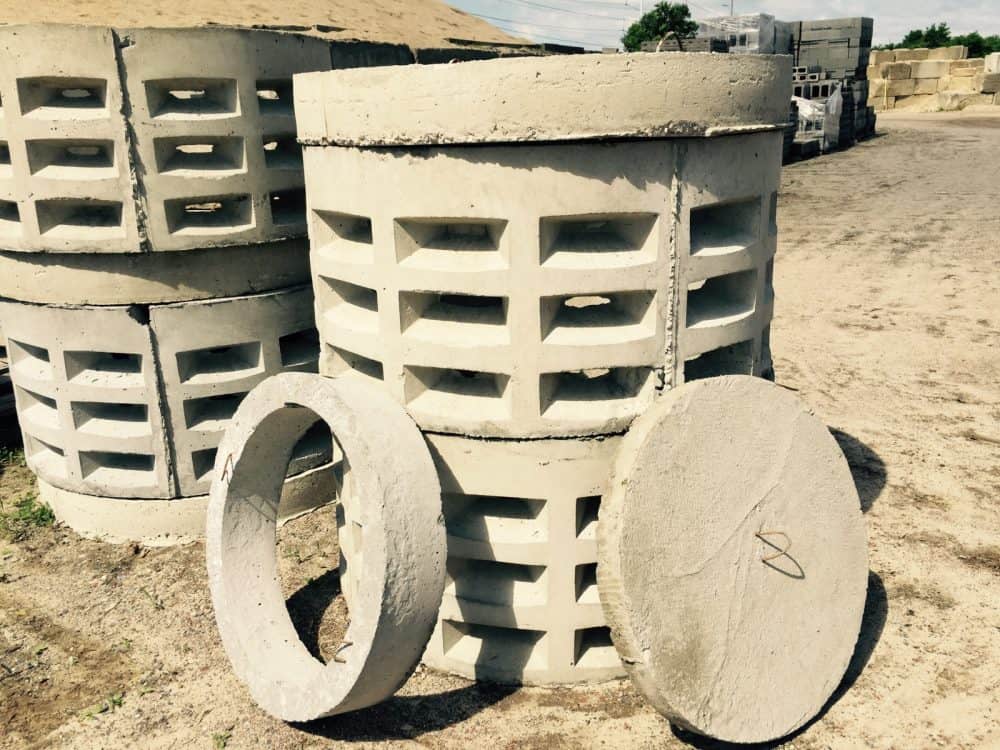
Large concrete retaining wall blocks, including what are commonly called bin blocks or ecology blocks, are precast retaining wall blocks that can weigh anywhere from a few hundred pounds to several tons each. They’re stacked without mortar, relying entirely on gravity and their own mass to hold back soil, fill, or other material. A properly designed gravity retaining wall blocks system using large precast units can handle heights of ten to twelve feet without reinforcement — and with engineered geogrid systems, commercial retaining structures can reach significantly greater heights.
Bin block retaining walls are the workhorse of commercial retention. You’ll see them used for material storage yards, highway applications, industrial site grading, and anywhere a wall needs to go up quickly and hold a lot. They’re not the most beautiful option, but they’re extremely durable, reusable, and cost-effective at scale.
For contractors and developers working in Nassau County, sourcing large-format blocks through a supplier with the right equipment matters as much as the blocks themselves. These units require flatbed delivery and, in many cases, a crane or telehandler for placement. Having a supplier with an owned fleet — dump trucks carrying up to 40 cubic yards and flatbeds holding up to 22 pallets — means you’re not coordinating between multiple vendors on a tight project schedule.
Precast retaining wall blocks in smaller formats bridge the gap between residential interlocking systems and full commercial bin blocks. They’re factory-manufactured to consistent dimensions and strength specifications, which makes them reliable for projects where uniformity matters. For anything structural — holding back a driveway, supporting a pool deck, managing a significant grade change near a building — precast and large-format blocks deserve serious consideration.
Where to Get Retaining Wall Materials on Long Island
The block you choose matters. So does where you get it. A supplier who can answer real questions — about soil conditions, drainage, block selection, and quantity estimates — is worth more than the lowest price per unit from a warehouse where nobody knows the difference between a gravity wall and an interlocking system.
We’ve been supplying retaining wall blocks and related materials to Long Island homeowners and contractors since 1972. Our eight-acre site in East Setauket has materials on display so you can see them before you buy — not just a catalog photo, but the actual block in natural light, at scale. We carry Belgard, EP Henry, Libertystone, and Hanover Architectural Products, along with everything else a retaining wall project needs: base aggregate, drainage stone, Portland Cement at $15.50 per bag, Mortar at $13.50 per bag, and pavers starting at $2.38 per square foot.
If you’re planning a retaining wall project in Nassau County and want to talk through your options before you commit, reach out to Troffa Materials Corporation. We’ll help you get the material selection right the first time.